


COLLECTIVE EXHIBITION
States of Place. States of Being.
Curatorial
Statement
War leaves invisible wounds that are passed down from generation to generation, carried forward from the past to the present and on one into the future. This new group exhibition entitled States of Place. States of Being. has been conceived in two parts that dialogue between the visible and the invisible, between the traces left by the Yugoslav Wars of the 1990s on the territories, and those inscribed within bodies and memories.
States of Place is conceived as a contemporary archaeology. It observes the visible and invisible traces left by the wars on the territories of the former Yugoslavia, in its urban and rural cities and landscapes. It explores how inhabitants today move within these spaces marked by history. Taking place in Marseille from 10th of January to 8th of February 2026 at Spazio.
States of Being takes us into the unspeakable, into what persists within the human after devastation, beyond language. It evokes the invisible imprints of trauma, the ways in which they transform, are diverted, or settle into oneself, how everyday gestures become coping mechanisms. Taking place in Paris and Marseille, dates and place to be confirmed.
States of Place. States of Being. is a threshold space where the questions of what remains, how we endure and in which states can we survive in order to simply emerge from the nightmare and recognize the trauma. The exhibition invites a relationship to the past that goes beyond commemoration: The aim of this curatorial research is not to re-write history, but to understand how artistic practice can be used to process and digest collective trauma and digest collective and intergenerational trauma. This exhibition examines trauma is still living in the everyday life of people from the Balkans 24 years after the 1990s wars ended. How the consequences of traumatic war experiences are being approached by the second generation that lacks the first-hand experience of the war but are still dealing with its impact without a language to describe it.
In these times of crisis we have all become witnesses to ethnic cleansing and genocide, to environmental devastation, we all are helpless in the face of such madness and terror. This is the nightmare we must wake up from. How can we as a collective process these traumas and embrace our responsibility to the present and the future, not simply be victims of the past. How do we Embrace the Silence, Embrace the Past, and Embrace the Future.
Emilia Trifunovic
Armin Graca, Points of Impasse


Ongoing project
2019 - present
"War is over. But I wonder, can a war really be over by signing a peace treaty and drawing a 1080km long invisible border? Thirty years have passed since the Dayton agreement was signed, but my country and its people remain divided. Our identity has been shaped by conflict, crafted by its violence. Consciously or not, hatred is passed on from generation to generation - a legacy from a war that is still fresh in people’s minds. I remember celebrating with my family, and father fresh out of the war when they signed the Peace Agreement which established the Inter-Entity Boundary Line (IEBL). It effectively divided the country into two entities and one district, cementing ethnic divisions. It was never meant to be a permanent solution, so over time it created a sort of limbo state. A limbo state that became my everyday life. I started photographing the places where the IEBL passes to highlight the absurdity and dysfunction created by it. Only to later realize that it could show much more. Growing up in a post-war society where each ethnic group is represented by its own leaders and parties, I have witnessed ethnic tensions and divisions getting stronger. Separate education systems work to enforce the divisions, and each side imposes its historical perspectives and political ideologies through the system. Thus creating another generation with the same problems and starting another cycle of hatred. A divided country cannot function properly and this reflects on its people - the population of Bosnia and Herzegovina has been on the decline in the last decade. I created Points of Impasse, a photography project, to explore the lasting impact of war and division on the people and places of Bosnia and Herzegovina. The project is centered around a politically divided terrain that impacts both individual and collective perceptions, creating a space that cannot be separated from the holders of a shared identity."
Ivan Tomasevic
sitre et rs
Blerina Muriqi, Abrupt


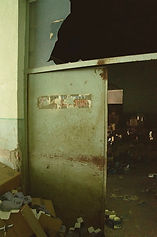
"I am the daughter of a former industrial worker. One who grew up hearing all about the engineering capacity Kosovo could have today. One who spent her playtime within industrial ruins so gigantic that little child Blerine could get lost in them for hours. I always knew that factories had something in them. Their presence was always felt so strongly by me, and the stories of their workers from family, relatives, and communities even stronger. Collectively, we have failed to preserve and collect such stories, to save such spaces, and to educate about this past, but as an individual, architect, as a creative worker, I felt a responsibility to document these experiences and stories from different industrial working communities across Kosovo. The industrial development from the early ’60s to the late ’90s contributed not only to economic growth through production but also to education, employment, art & culture, and it entirely changed the way of living.
However, factories did not operate alone. They functioned in a chain-like network throughout all of Yugoslavia: mother factories and sub-factories. This system of collaboration meant that certain processes were carried out in specific countries where the sub-factories were situated. This method resulted in better efficiency in the production process, better resource management, and ensured the inclusion of all states in the industrial network within former Yugoslavia. People were connected; people were taken care of, nourished, and developed not only financially and infrastructurally but also emotionally and spiritually. After the war, production and everything else known as industrial development collapsed. Factories stopped working immediately, and workers were sent home. There are dozens of industrial sites where you can see, from the way products were left on the workstations, how quickly this work was interrupted. Those workers never returned; factories never opened again, but they were left as remains of a heavy treasure which today carries the weight of memories, history, labor, and the pain of a post-war reality. We never knew how to deal with it all. There is no manual, and we were trying to figure it out as we go.
My parents’ and grandparents’ generation, who were the main contributors of this era, speak with such appreciation of this time but with hesitation as well—a hesitation, which we know and understand, was shaped by the fear and uncertainty of the political changes of the time. After the war, they were left with a deep confusion about how to deal with these industrial sites: do we see them as memories to preserve or as relics from a rather difficult political past? I’m sure that seeing them as abandoned spaces is also not the way. This uncertainty, this lack of a clear path, and the ever-growing danger of the disappearance of such structures have really fueled my motivation to document these sites in any way possible. That’s why these photographs exist and will be continued as a series of documental work. In the hope of understanding how we inherit, process, and preserve a legacy that we so hardly built but was so abruptly shattered by conflict."
Blerina Muriqi
site et rs
Ferdi Limani, Invisible Imprints


"My practice emerged twenty-five years ago, not from a desire to observe as an outsider, but from a profound necessity to serve as a participant. Amidst the chaos of the disintegration of Yugoslavia, I picked up the camera as an act of resistance. Over the last quarter-century, this impulse has evolved into a duty of witnessing, building an archive that challenges the linear narrative of conflict resolution. My work deconstructs the expectation that war follows a clean trajectory: conflict, intervention, peace, success. I always try to frame the post-war reality as a "perpetual present," where the past is not a chapter we have closed, but a living atmosphere we continue to breathe. I seek to capture the invisible inscribed within the visible documenting not just the events of history, but the emotional duration of survival, and the slow, often silent process of enduring what comes after. This journey began with a specific, perhaps naive hope, that I was documenting the difficult transition toward a guaranteed brighter future. However, the body of work reveals a more complex reality. As the site of the last war of the Yugoslav disintegration, Kosovo is not the straightforward story of success I once envisioned. While the atrocities stopped, the country continues to struggle with a past that refuses to fade. My work documents this struggle, capturing a society in flux. I photograph the transformation of the land and the people, revealing that we are not merely "post-war," but living in a state where the war has settled into the everyday. I capture the dissonance between the official narrative of political progress and the internal reality of a people who are still waiting for the nightmare to truly end. The "good days" have not simply arrived,; they are being painfully carved out of the remnants of the old days. These photographs serve as a contemporary archaeology. I document the physical scars on the landscape of Kosovo, the architecture of reconstruction and the spaces where the debris of the 1990s still lingers. They dialogue with the visible traces left by the wars, grounding the viewer in the undeniable reality of the Balkans. Through photographs of my fellow Kosovars’ first days returning home, and of the ongoing wait for missing persons, I investigate how the “invisible imprints” of devastation settle into the body. I look for the silence in the eyes of the second generation, those who lack the first-hand experience of the war but are still dealing with its impact and try to find a new life elsewhere. Ultimately, my contribution is an invitation to digest, rather than merely commemorate. In a time where we are helpless witnesses to new waves of ethnic cleansing and terror, globally."
Ferdi Limani
site et rs
Ivan Tomašević, Plima


Plima, 2022 —
"The consequences of the Yugoslav wars remain deeply inscribed in Croatian society. While monuments and political narratives preserve
official memories, the everyday realities of veterans are less visible. Many face untreated trauma, economic hardship, and social marginalization, finding ways to get by without much institutional support. Plima turns attention toward these quieter and often overlooked forms of endurance. The project focuses on a small circle of war veterans, including my father, tracing how they carry the past into daily life within the intimate spaces of home. Rather than seeing trauma as a closed event, Plima approaches it as a living condition, circulating through bodies, conversations, and family bonds. My position as a son gives both proximity and tension: access built on love, but also the weight of witnessing. Through this lens, the project reflects how memory and emotional inheritance move across
generations. Rooted in a region still shaped by the legacy of war, the project speaks to broader questions of how individuals and communities live on after conflict — how they rebuild forms of belonging, carry unhealed memories, and find moments of humour and connection amid endurance. Plima - Croatian word for “High tide”, used as a radio signal during the Croatian Independence War."
Ivan Tomašević
Plima book : https://ivantomasevic.pb.photography/books/plima-artist-book
site et rs
Jeanne Frank, They Forgot To Treat Us


Adela Jušić est née en 1982. Âgée d’une dizaine d’années lors du siège de Sarajevo, elle grandit dans une ville ravagée par les bombardements incessants et les tirs des snipers. Aujourd’hui artiste reconnue de la capitale bosnienne, elle appartient à une génération sans repères, meurtrie par la guerre et la mort, exilés perpétuels
d’un temps qui semble s’être figé. “Le 3 décembre 1992, mon père, un sniper, a été tué par un autre sniper, une balle dans l’œil droit.”
Sous la forme d’un journal intime, « They forgot to treat us » nous plonge dans son quotidien marqué par l’addiction à la drogue et l’alcool. Adela passe ses journées confinée dans son appartement où elle reçoit ses amis, parfois pendant plusieurs jours, jusqu'à l’épuisement. Portrait intime d’une génération traumatisée par la guerre de 92-95 en Bosnie-Herzégovine, j’ai recueilli pendant cinq ans ce témoignage de leur mémoire et de ses conséquences sur leur existence présente. “Ils nous ont donné à manger, reconstruit nos monuments historiques mais ils ont oublié de soigner les gens.”
Jeanne Frank
site et rs
Mitar Simikić, Šarac


This photographic series, created between October 2012 and April 2013, follows the life of Ranko Mijatović Šarac Ranko Mijatović Šarac, a war survivor from the northern part of Bosnia and Herzegovina. Through his everyday life, the work reveals a broader portrait of a society that, decades after the conflict, continues to exist in a state of quiet erosion. In this environment, place and person do not appear as separate categories but as intertwined conditions—each shaping and reflecting the other, each bearing traces of what has been lost.
Šarac lives in the village of Mezgraja, in a country where abandoned homes, dwindling rural populations, and the departure of younger generations have become an enduring post-war landscape. It is within this context that the series documents not only one man’s trajectory but also the psychological and geographic residue of a society forced into stillness. Once a drummer in the lively years of the 1980s, Šarac saw his former rhythm dissolved by war, economic collapse, and the disintegration of his family. Today, his life is narrowed to a few neighbors, occasional heavy labor, and alcohol as a means of temporary escape from a reality that has steadily closed in on him.
The conceptual framework of the project focuses on the relationship between interior states and exterior spaces—on how geography becomes biography. The camera records the textures of daily survival: cramped rooms, collapsing wooden structures, improvised arrangements, the quiet exhaustion embedded in gestures and posture. These visible details serve not only as documentary evidence but as extensions of psychological terrain. Šarac’s interactions with the camera oscillate between withdrawal and the subtle desire to be acknowledged, revealing how trauma, when prolonged, becomes indistinguishable from routine.
Mitar Simikić
site et rs
Una Tomašević, Rotten Paradise


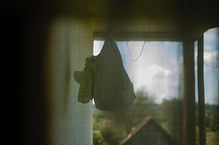
"Rotten Paradise is a meditation on the unspeakable, on what persists in the body and in the landscape long after devastation has ended, beyond the reach of language. The project traces the invisible imprints of intergenerational trauma, the way it transforms, settles into everyday gestures, routines, and the quiet tension of everyday life.
The work is rooted in a rural area near the river Una, a place that appears idyllic, almost untouched. Paradise at first glance, where only a few dozen inhabitants remain. Houses stand empty, overgrown fields hold mines and stories no one heard about. Time has swallowed what once defined life.
My grandparents live here, “off-grid”. They grow food, collect rainwater, heat with wood, and tend to animals that form a fragile, self-sustaining ecosystem around their home. Their world was reshaped by destruction, displacement - they were victims of ethnic cleansing and had to leave their home in order to survive - and the slow rebuilding that followed after the war ended. They returned home only to find empty walls, no doors, no windows, no furniture, no books, no personal objects, no animals… to survive and to rebuild was their only goal. It is a way of living in which resilience and vulnerability coexist, where every gesture holds a trace of what was endured. To survive is the trauma, not as a single event, but as a condition that seeps into routines, relationships, and the very atmosphere of the home - the way of living that shapes the state of being.
I follow my grandparents' stories about the past and the war through fragments, grasping at associations, memories, and symbols that surface as they speak. These symbols uncover a whole world beneath the surface - what is perceived as a Paradise is the outer shell; beneath it, time unravels and memory persists in gestures, and spaces, even when it remains unspoken."
Una Tomašević
site et rs
